Fisher
Overview
Part I
- IP goods nonrivalrous, creators at a disadvantage to recoup development costs.
- five strategies to prevent this situation:
- Govt’s engage in tech innovations
- i.e. Dept. of Health, Dept. of Agr., etc.
- Gov’t subsidy of innovation by private investors.
- Bounties/rewards on innovation
- Trade Secret Law
- IP rights
- Govt’s engage in tech innovations
- Gov’t reliance on the last tends to rely heavily on viability of first four.
Sec. A - Theoretical Inquisition
- Disadvantages to IP
- Costly to administer
- Impede upon cumulative innovations
- Impowering innovators with IP allows for price-gouging and loss of consumer surplus.
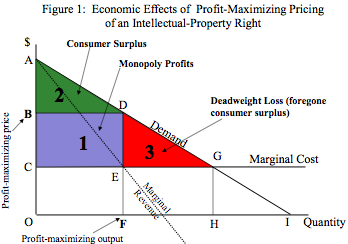
- This means that IP rights should not be extended haphazardly.
Sec. B
Some say extend property rights everywhere and let the market decide. However, there are many fields where people just _aren’t_ economically rewarded by the full social worth of their investments- why intellectual product? what makes this field so special?
Sec. C - Patents generate economic waste
- Case 1 - Many firms all invest energy into a potentially lucrative technology breakthrough in order to be “first”. Those that don’t get there first have generated net loss.
- Case 2 - similar scrambles at the second level of innovation following a breakthrough
- Case 3 - investment of development of similar but noninfringing technologies to circumvent patent.
- Codifying a system that minimizes these wastes is a ridiculously difficult proposition.
Sec. II - Empirical Study
We will examine:
Pharmaceuticals
- Patents work well here. In no other industry are they as effective at fostering innovation.
- Suggested reason - patents boost the “imitation cost” much higher than in any other industry
- >> Why is this? <<
- High risk
- High Reward
- V. EAsy Reverse engineering.
- Low manufacturing costs.
- However, see earlier economic chart, think of social consequence of ‘rent’ in this context. Think AIDS.
- Compulsory Licensing, imperfect pricing as solution.
Biotech
Similar to biotech in four qualities that make patents work.
Dissimilar in that:
- gov’t/uni research funds most major developments. over 90% of patents applied for stem from publically funded research.
- researchers in this field, for whatever reason, appear to be largely altruistic
- research is highly cumulative.
because of this, strong patent protection may not be beneficial in this field, resting largely on cumulative development.
Aviation
Noticed in ‘71 that this industry relies more on lead-time and learning-curve advantages than patents.
History of aviation - the Wright patent
Wright Bros patent turbulence stabilization. Curliss does it much better, but courts decide it infringes. They squabble, no licensing is worked out. WWI happens, nobody wants to make planes for fear of patent infringement lawsuits. Congress has to get involved to threaten to pass legislation annihilating the Wright patent. Licensing is finally agreed to.
An example of a hurt.
Computer Software
Rights increasing over time, yet no real noted rapid development increase. Programmers believe this hampers their work. Third, highly cumulative field.
Also, programmers unlikely to publish on patented schemes. Hard to know when one is running into patent trouble.
Also, program interoperability is strongly socially desirable.
Summary
Essentially making the argument that IP needs to be treated differently in each field _if it is not a natural right_, as utility is not going to be preserved by one single broad interpretation of IP.