Applications of Information Systems
Stakeholder perspectives
Record Company (Peter Woodman)
Perspective
- Corporate entity. Wish to maximize profit, protect rights.
- Well-entrenched corporate entity. Slow to give up current stake.
Situation
- Situation is dangerous, as technology has moved much faster than the corporate strategy. People are already not using your old-world distribution method because it is less convenient.
- A record company exists to get media to the hands of the consumer. We are currently losing this game.
- Payola not working as well as it used to.
Constraints
- Wish to maintain control of the distribution method of the product.
- Optimal situation is to maintain all control.
- Base goal is to still have a piece of the pie.
Proposal Constraints
What we have that the P2Ps don’t is a lot of money and a massive backcatalogue. We can use this to our advantage. If we offer our entire catalogue for sale- ALL of it- we can provide a system that is more appealing to the end user. Media costs are virtually nonexistent. We can keep prices low.
Lawyer (Ian Carter):
Perspective
- In most cases large body of legal consultants either embedded directly in the company or hired as consultants.
- Goal is to protect the commercial interests and rights of the client. Seek out and prosecute violators of copyright and intellectual property rights.
- Ensure company policy is lawful and will not cause legal action from the consumer side.
- Piracy vs. backup vs. fair use:
⚠ P2Pfilesharing, illegal downloads, hardware (CD) copy protection
Situation
- With the DMCA the Legislature has just started to expand copyright law into the digital realm. It is now up to the lawyers and courts to transpose and proove the effectiveness of these laws.
- Over the last year the use of
⚠ P2Pfilesharing and other piracy tools was effectively reduced in part due to determined legal action campaigns. - Various efforts are being made to introduce copy protection into hard- and software. The legal issues involve many stakeholders. The battle will presumably go on for a long time and will be won only by compromises from all sides.
Constraints
- make illegal filesharing more difficult
- make it possible to uniquely identify every media file download to track possible sharing violations
- file lawsuits against illegal music distribution websites and
⚠ P2Pusers - users must agree to terms and conditions prior to download, idealy have address information in accounts or at least IP log
Proposal Comments
The presence of embedded ⚠ IDs in the files will most likely encourage “normal users” to acquire their music files in a fair and legal fashion. Hackers and Crackers will even as likely continue to break or remove steganography codes. Finding and prosecuting these individuals will be the main goal for music industry legal departments and federal investigation. In general the legal sides has no own opinion though - the concerns of the client are our concerns.
Poor Student who Loves Music (Monica Yuen):
Perspective:
* Student that wants to save as much money possible in many aspects of life, including his love for music(save money on music).
* Music on internet has always been viewed as “free”, does not see (music) file “sharing” as piracy.
* Fear of lawsuits and the numerous possible costs associated with them.
* if Music isn’t “free” not all music have the same “worth”
Final Decision Impacts:
The system (final decision) proposed would mean for me as a student a stop to the free music downloads. Since downloads will be tracked using steganography, this would only make it easier for record companies to track and file lawsuits for those “misusing” the music files illegally. The reality of being able to track down the origin of the shared music files could possibly be only a threat (lawsuits) to the ones already in the practice of file sharing or be a turning point that shifts listeners toward the direction of legal downloads. Although this proposal seems to favor record companies more than listeners, but at the same time it is also somewhat providing a way to make music more affordable to customers like me. Sliding scales on the prices of music allows for some music to be fairly cheap and prevents music from being to pricey (ex. price rises as demand for that particular music file rises, but eventually as price rises above the demand or its worth to the customers, the price will decrease as the demand goes down).
As for the value-add through extensive metadata, this would be a positive addition for me. With this, it would allow me to have easier access to artist/song information and background. Lastly, if the entire catalogue was really made available (all of it, ALL), then I don’t see how this could in any way negatively affect me. The decisions made would certainly alter my usual norm of obtaining music, but it is not too preposterous or unreasonable to adapt to. Added features in this system such as providing users access to artist information, will help in (me) easing the routine of massive illegal downloads to strictly only legal uses of music files.
Interface Designer/Programmer (Zach Hale):
Perspective
- Try to maximize functionality and amount of features and information while keeping ease of use
- Provide many formats and sizes with very little or no DRM to expose the system to a maximum userbase
- Not as much concerned with prices as making this a portal for information and a good alternative to current-day music stores
Situation
- This would be a revolutionary system to go up and above all other systems out there and would provide a lot for not only the people buying the music, but also for the record companies to be able to leverage prices
- This system would be self-maintaining as it would allow for people to find all of the most popular music while still being able to search out harder to find songs at lesser prices
- It wouldn’t inhibit the user from harmful DRM and would allow the user to use the files on absolutely any system
Constraints
- Need to keep the record companies from sliding prices too high not to bring negative conotations to the system
- Make sure all metadata is correct so people don’t find false information. Want to eliminate false metadata to that would skew results
- Need full access to all the music with complete cooperation when adding to the system
Proposal Comments
With a system that contains all the information anybody would want as well as high quality formats that don’t inhibit the usage of the files, we can revolutionize the industry with our system. This will provide an information portal that just so happens to have an extremely comprehensive library downloadable for prices both the users and record companies can agree on while limiting control over harmful DRM on the files.
Pedantic Diatribe
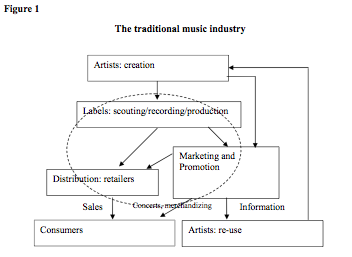
The problem that the record industry faces is that for the past 5 or 6 years, it has been beaten at its own game (quite badly) by hobbyists and the internet. The record industry exists as a medium between artists and consumers, who provide two main services- A&R, or putting artists in the public eye, and then encapsulation of said artist’s work into a distributable form. It is open to debate whether or not the record industry has failed at the former service at this point- this author thinks so, but this author also considers it an uninteresting topic. As to the latter, the record industry has been trounced soundly. The internet is a far more effective distribution medium. There is no need for a cd to be pressed and delivered to vendors across the country and the world- once recorded, it can be encoded and stored anywhere on the internet and distributed immediately, again and again. This keeps the suits awake at night.
The record industry has furthermore gotten themselves into an even larger pickle by ignoring this problem for such a long time. Producers of fashionable/luxury items have targeted the group of young adults aged 18–25 the hardest for quite some time now, as they realize it is at this time when people begin to have money but still lack restraint, and furthermore begin to form purchasing habits. This current generation of 18–25 year olds, however, have learned that purchasing music is an option, as it can be had for free on the internet. All of them. This is a problematic situation for someone trying to program a new crop of consumers.
Current practices of the recording industry in quelling this rebellion are to sue the pants off of people they catch (valid) and to greatly restrict rights of what one can do with files downloaded legally over the services they offer (very questionable). People do not percieve digital copies of music as having equal value to physical copies already, and adding restrictive DRM to these files makes people percieve these files as having even less worth than before.
DRM is not a battle that the record industry will win. Furthermore, it is not a battle that needs to be won. We feel that the threat of legal action is a more effective deterrent to the practice of online file swapping. The reason this was never a problem before was because it was difficult for users to copy physical media on a large scale and give it to all their friends, but unauthorized copying did still exist on a smaller scale, through tape dubbing and more recently cd burning.
One of the reasons that the record industry had been dragging its heels on diving into the digital music game, this author supposes, is this question of rights. Offering files in digital format, one might suppose, would attract attention to the fact that this stuff is really, really easy to share around. This would no longer be a problem if these files could be tracked, however. The threat of legal repercussions has been long since proven to be an effective method of affecting change on the behaviors of society. To take advantage of this fact, we feel that not DRM, but steganography, is an approach that is nearly as effective as DRM without limiting the uses of the sold media.
The Final System
Our system would be based on the following points:
- Download tracking through steganography. Perhaps a controlled format.
- Value-add through extensive metadata. Searching by all this metadata, as well.
- Sliding scale on prices based on demand and rating.
- Entire catalogue available. All of it. All.
further references
- 1) DMCA
- 3) US Copyright law
- 4) (fasttrackdcn.net)
- 5) Legal Action Results (IFPI.org)
- 6) IFPI Piracy Statistics (IFPI.org)
- 7) International Association of Entertainment Lawyers (IAEL.org)
- 8) M Peitz, An Economist’s Guide to Digital Music.
- 9) P2P, Online File Sharing, and the Music Industry
- 10) Music Publishers Association (mpa.org)
- 11) International Confederation of Music Publishers (icmp-ciem.org)